Chutes and Ladders Game Instructions: A Comprehensive Guide
Chutes and Ladders is a classic family board game for 2-4 players, aged 3+, focusing on simple number recognition and turn-taking skills.
Chutes and Ladders, a beloved board game enjoyed by generations, offers a delightful introduction to game playing for young children. Originally known as “Snakes and Ladders,” its simple mechanics and vibrant design make it instantly appealing. The game centers around a numbered grid where players advance based on spinner results, encountering ladders that provide shortcuts and chutes that lead to setbacks.
This isn’t about strategy; luck dictates the outcome, fostering a sense of fairness and excitement for all participants. It’s a fantastic way to teach basic number recognition, counting skills, and the concept of taking turns. The game’s enduring popularity stems from its accessibility and the joy it brings to family game nights.
Game Overview
Chutes and Ladders is a straightforward race to be the first player to reach the final square on the game board. Players begin at square one and progress by spinning a spinner, moving their playing piece the corresponding number of spaces. The board features ladders, which allow players to climb upwards, accelerating their journey. Conversely, chutes send players sliding down, creating unexpected delays and playful frustration.
The game emphasizes luck over skill, making it ideal for young children. There are no complex rules or strategic decisions to make; it’s purely a game of chance. The objective is simple: spin, move, and hope for ladders while avoiding the dreaded chutes!
Components of the Game
A standard Chutes and Ladders game includes several key components. First, the Game Board itself, a colorful path of numbered squares featuring illustrations of chutes and ladders. Second, Playing Pieces – typically four distinct tokens, one for each potential player, often housed in plastic stands. Finally, the Spinner is crucial; it dictates how many spaces a player moves on their turn, usually numbered 1 through 6.
These components work together to create a simple yet engaging gameplay experience. The quality of these elements can vary between editions, but the core components remain consistent across most versions.
Game Board
The Game Board is the central element of Chutes and Ladders, featuring a numbered, winding path of squares; It’s visually distinctive, showcasing vibrant illustrations of ladders leading upwards and chutes descending downwards. These aren’t merely decorative; they represent shortcuts and setbacks within the game. The squares are sequentially numbered, typically from 1 to 100, guiding players towards the finish.
The board’s design is intentionally simple, catering to young players. The chutes and ladders are prominently displayed, immediately conveying their function within the game’s mechanics. It’s a colorful and inviting landscape for a race to the top!
Playing Pieces
Playing Pieces in Chutes and Ladders are typically small, colorful tokens representing each player. Traditionally, these pieces are shaped like people or animals, adding a playful element to the game. Each player selects a unique piece at the beginning, distinguishing their progress on the board. They are often designed to fit securely into plastic stands, aiding in easy movement along the numbered path.
The number of playing pieces included usually corresponds to the maximum number of players – typically four. These pieces are essential for tracking each player’s position and navigating the chutes and ladders throughout the gameplay experience.
Spinner
The Spinner is a crucial component of Chutes and Ladders, dictating how many spaces each player moves on their turn. It’s typically a circular cardboard or plastic dial divided into numbered sections, usually ranging from 1 to 6. Players spin the spinner to determine their movement, introducing an element of chance into the game.
The spinner’s design is often bright and colorful, enhancing the game’s visual appeal. Spinning the spinner is the first action a player takes each turn, and the resulting number directly influences their progress towards the winning square. It’s a simple yet effective mechanism for driving the gameplay forward.
Setting Up the Game
Setting Up the Game is a quick and easy process, making Chutes and Ladders accessible for young children. First, Placing the Board involves finding a flat, stable surface where all players can comfortably reach. Next, each player needs to engage in Player Piece Selection, choosing a uniquely colored playing piece and placing it into its plastic stand.
Finally, all players begin at the Starting Position, which is typically square number one on the game board. Ensure everyone understands these initial steps before commencing play. A properly set-up game ensures a smooth and enjoyable experience for all participants, ready to climb ladders and avoid chutes!
Placing the Board
Placing the Board correctly is the foundational step to enjoying a game of Chutes and Ladders. Select a flat, stable surface – a table or the floor works well – ensuring ample space around the board for all players to comfortably reach and move their pieces. The board should be positioned so that all players can clearly see the entire game path, including the ladders and chutes.
Avoid uneven surfaces that might cause the board to wobble or pieces to accidentally slide. Proper board placement contributes to a fair and enjoyable gaming experience, preventing frustration and ensuring everyone can participate fully. A stable setup is key!
Player Piece Selection
Player Piece Selection adds a personalized touch to the game. Typically, Chutes and Ladders includes several uniquely colored playing pieces – often shaped like people or animals. Each player chooses one piece to represent them throughout the game. Ensure everyone selects a different color or design to easily distinguish their progress on the board.
Some versions include plastic stands to help secure the pieces, especially for younger players. Encourage players to pick a piece they like, fostering excitement and engagement. Once selected, players should keep their chosen piece safe until it’s their turn to begin the climb!
Starting Position
Starting Position is crucial for a fair game of Chutes and Ladders. All players begin at the very first space on the game board, usually marked with a distinct starting symbol. Before the game commences, ensure each player’s chosen playing piece is correctly placed on this designated starting square.

The order of play is determined by the initial spin of the spinner. The player who spins the highest number goes first, followed by the others in clockwise order. This simple setup ensures everyone has an equal opportunity to begin their journey up the board, navigating ladders and avoiding those pesky chutes!
Gameplay: Taking Your Turn
Gameplay in Chutes and Ladders revolves around simple turns. Each player, in clockwise order, begins their turn by Spinning the Spinner to determine how many spaces to move their playing piece. The number spun dictates the exact number of squares the player advances along the numbered path on the game board.
Players must carefully Move Your Piece, following the numbered sequence. Landing on special squares – the base of a ladder or the top of a chute – triggers immediate actions. The game continues with each player taking turns until someone reaches the final square, signifying victory!
Spinning the Spinner
Spinning the Spinner is the core mechanic for movement in Chutes and Ladders. Before each turn, a player spins the spinner, which is typically marked with numbers. The number the spinner lands on determines how many spaces the player will advance their playing piece along the game board’s numbered path.
It’s a purely luck-based element; there’s no strategy involved in the spin itself. Players simply accept the number rolled and move accordingly. This element of chance is central to the game’s appeal, making it accessible and enjoyable for very young children.
Moving Your Piece
Moving Your Piece is straightforward after spinning the spinner. Players advance their playing piece along the numbered squares of the game board, counting the number of spaces indicated by the spinner’s result. Movement always proceeds forward, following the sequential order of the squares.
If a player lands on the bottom of a ladder, they immediately climb to the top. Conversely, landing on the top of a chute forces the player to slide down to its base. These special squares introduce unexpected twists and turns, adding excitement to the game.
Understanding Ladders
Ladders represent fortunate opportunities within the Chutes and Ladders game. When a player’s piece lands precisely on the bottom square of a ladder, they are granted an immediate ascent to the corresponding top square. This provides a significant advantage, propelling them closer to the winning space.
The ladders symbolize positive progress and rewards, offering a shortcut across the board. Landing on a ladder is always a welcome event, as it bypasses several spaces and accelerates a player’s journey. It’s a key element of the game’s dynamic, creating moments of excitement and hope.
Landing on the Bottom of a Ladder
A pivotal moment in Chutes and Ladders occurs when a player’s token lands directly on the square at the base of a ladder. This isn’t merely a pause; it’s an instant elevation! The rules clearly state that upon reaching a ladder’s starting point, the player immediately moves their piece upwards to the square located at the ladder’s top.
This fortunate landing bypasses all the intervening spaces, offering a substantial advantage. It’s a visual representation of progress and good fortune within the game, swiftly advancing a player closer to the ultimate goal of reaching the final square and claiming victory.
Climbing the Ladder
Successfully landing on the bottom of a ladder initiates the “climbing” phase. This isn’t a gradual ascent; it’s an immediate transport! Players don’t roll again or count spaces – they instantly move their playing piece to the square at the top of the ladder. This mechanic represents positive progress and rewards fortunate positioning on the game board.
The ladder serves as a shortcut, bypassing numerous spaces and accelerating a player’s journey towards the winning square. It’s a visually satisfying element of the game, symbolizing overcoming obstacles and achieving advancement. This quick climb is a key feature that distinguishes Chutes and Ladders.
Understanding Chutes
Chutes represent setbacks in the game, acting as swift descents that hinder a player’s progress. Unlike ladders, landing on the top of a chute triggers the slide. Players don’t get a choice; they immediately move their piece down to the chute’s bottom square, regardless of any remaining moves from their spinner result.
This mechanic introduces an element of unpredictable challenge, mirroring real-life obstacles. The chutes visually demonstrate the consequences of misfortune, adding a layer of suspense to each turn. These downward spirals can dramatically alter a player’s position, emphasizing that progress isn’t always linear in Chutes and Ladders.
Landing on the Top of a Chute
If, unfortunately, your playing piece lands directly on a square depicting the top of a chute, prepare for a rapid descent! This is a key element of the game’s unpredictable nature. Unlike ladders which offer advancement, chutes immediately send you backwards. There’s no option to avoid the slide – it’s an automatic consequence of your spin.
You must instantly move your piece down the chute to the square at its base. Any remaining moves from your spinner are forfeited; the chute takes precedence. Landing on a chute can be frustrating, but it’s a core part of the Chutes and Ladders experience!
Sliding Down the Chute
Once your piece lands on the top of a chute, the slide is immediate and unavoidable! Carefully move your playing piece down the chute, following the illustrated path to the lower square. This represents a setback in your journey to reach the final space. Remember, landing on the top of a chute means you lose any remaining moves from your spin – the descent is the sole action.
Don’t worry about landing on other players during your slide; it doesn’t affect their position. The chute simply transports you to a lower number, adding to the game’s element of chance and excitement!
Winning the Game
The objective of Chutes and Ladders is delightfully simple: be the first player to reach the very last square on the game board! You don’t need to land exactly on the final space; if your spin allows you to move past it, you’ve still won. The game ends immediately when one player achieves this milestone.
There’s no need to continue play for other players once a winner is declared. Celebrate the victor’s climb up the ladders and avoidance of the chutes! It’s a game of pure luck, making every spin and landing a thrilling moment for all participants.
Number of Players
Chutes and Ladders is designed for family fun, accommodating between two and four players. This makes it perfect for a quick game with a sibling, a friendly competition with parents, or a small group of friends. The game remains enjoyable with any number within this range, ensuring everyone gets a fair share of spins and opportunities to climb ladders.
While the game is best suited for 2-4 players, it can technically be played with slightly more, though it might extend the playtime. The core experience is optimized for this player count, fostering engagement and excitement throughout the game.
Age Recommendation
Chutes and Ladders is wonderfully accessible to young children, with a recommended age range starting at 3 years old. This is due to its simple gameplay, requiring no reading skills – players simply spin the spinner and move their piece accordingly. The bright colors and engaging visuals further enhance the experience for preschoolers.
However, the game’s appeal extends beyond this age group. Older children and even adults can enjoy a lighthearted, nostalgic game. While younger players focus on number recognition, older players can appreciate the element of luck and the thrill of the climb!
Variations in Game Rules
Chutes and Ladders, while straightforward, allows for fun house rules! Some families might implement a rule where landing exactly on the last square wins, regardless of the spin. Others introduce a “rescue” system, allowing players to help others avoid chutes.
For simplified rules with younger players, consider removing the concept of needing an exact number to win; the first to reach the final square wins. Alternatively, focus solely on counting and color recognition, ignoring the chutes and ladders entirely for a purely numerical practice game. These adjustments enhance accessibility and enjoyment.
House Rules
House rules for Chutes and Ladders can significantly alter gameplay! A popular variation involves “immunity” – a player landing on a ladder gains protection from chutes for one turn. Another rule allows players to choose whether to take a ladder or chute if they land on its base/top, adding a strategic element.
Some families implement a “spin again” rule for landing on specific colors, speeding up the game. Others create penalty spaces, sending players back a few squares. Remember, the goal is to enhance fun and tailor the experience to your group’s preferences, fostering creativity and friendly competition!
Simplified Rules for Younger Players
For very young children, simplify Chutes and Ladders by focusing on color and number recognition. Remove the concept of winning; instead, emphasize completing the board together. Allow assistance with counting spaces, and verbally celebrate each ladder climb. Ignore the chutes initially, or reframe them as “shortcuts” back to easier spaces.
Focus on turn-taking and positive reinforcement. You can also reduce the number of spaces needed to reach the end. The primary goal is to introduce basic game mechanics in a fun, non-competitive environment, building confidence and early learning skills.
Strategic Considerations (Limited)
Chutes and Ladders relies heavily on luck due to the spinner’s randomness, offering limited strategic depth. However, players can subtly influence outcomes by observing the board. Recognizing spaces directly before ladders provides a slight advantage, as a higher spin increases the chance of landing on the ladder’s base.
Conversely, awareness of spaces preceding chutes allows for anticipating potential setbacks. While not a guaranteed strategy, mindful observation can marginally improve a player’s progression. Ultimately, the game prioritizes enjoyment and simple number practice over complex tactical maneuvers.
Game Board Design and Features
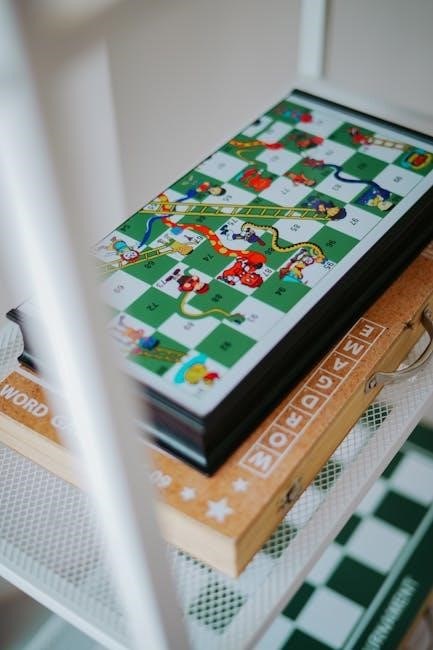
The Chutes and Ladders game board typically features a numbered, winding path of squares, often brightly colored and illustrated with engaging imagery for young children. Ladders are visually represented as ascending pathways, offering shortcuts to higher numbers, while chutes depict descending slides causing setbacks.
The board’s design emphasizes a clear progression towards the final square, usually numbered 100. Illustrations often depict positive themes on ladder squares and cautionary ones on chute squares, subtly reinforcing moral lessons. The layout is intentionally simple, facilitating easy understanding for preschool-aged players.
Historical Background of the Game
The origins of Chutes and Ladders trace back to ancient India, where it was known as ‘Moksha Patam’ – a game representing the path to enlightenment. This early version incorporated moral lessons, with ladders representing virtues and chutes symbolizing vices.
In the late 19th century, the game arrived in England, undergoing a Victorian-era transformation with a focus on moral character. Milton Bradley then acquired the rights in the 1940s, rebranding it as ‘Chutes and Ladders’ and simplifying the theme for a broader audience. The game’s enduring popularity stems from its simple mechanics and universal appeal.
Safety Precautions
Chutes and Ladders is generally a very safe game for all ages, but some precautions are advisable. Small components, like the playing pieces and their stands, pose a choking hazard for young children – adult supervision is crucial.
Ensure the game board is placed on a stable surface to prevent it from tipping over during play. Regularly inspect the spinner for any damage or sharp edges. Discourage running around the game area to avoid accidental collisions. Finally, store all game components securely when not in use, out of reach of infants and toddlers.
Cleaning and Storage
To maintain your Chutes and Ladders game, wipe the board and playing pieces with a slightly damp cloth to remove dust and debris. Avoid using harsh chemicals or abrasive cleaners, as these could damage the board’s surface. For stubborn marks, a mild soap solution can be used, followed by thorough drying.
When storing the game, ensure all components are present to prevent loss. Place the board, pieces, and spinner back into the original box, or a similarly sized container. Store in a cool, dry place away from direct sunlight and extreme temperatures to prolong the game’s lifespan.
Troubleshooting Common Issues
A frequent issue is losing playing pieces; replacements can often be found with similar tokens or through online retailers specializing in game components. If the spinner isn’t functioning smoothly, check for obstructions or ensure it’s properly attached. A stuck piece can usually be gently dislodged, avoiding forceful movements that could damage the board.
Disagreements about rules are common; referencing the official instructions resolves these. If a ladder or chute is damaged, carefully tape it if possible, or consider contacting the manufacturer for support. Always prioritize fair play and enjoyment!
Digital Versions of Chutes and Ladders
Numerous digital adaptations of Chutes and Ladders are available on various platforms, including mobile apps for iOS and Android devices. These versions often feature enhanced graphics, animations, and sound effects, providing a modern twist on the classic gameplay. Many online platforms also offer browser-based versions, allowing players to enjoy the game without downloading any software.
Digital versions frequently include single-player modes against AI opponents, as well as multiplayer options for playing with friends and family remotely. These adaptations maintain the core mechanics of the original game, making them accessible and enjoyable for all ages.
Chutes and Ladders and Educational Value
Chutes and Ladders, despite its reliance on luck, offers significant educational benefits for young children. The game reinforces number recognition as players count spaces based on the spinner’s result. It also introduces the concept of sequential order and helps develop basic counting skills. Furthermore, the game teaches children about consequences – ladders represent positive outcomes, while chutes symbolize setbacks.
Turn-taking is another crucial skill fostered by Chutes and Ladders, promoting patience and social interaction; The simple rules make it accessible for preschoolers, building confidence and encouraging early learning in a fun, engaging way.
Comparing Chutes and Ladders to Similar Games
Chutes and Ladders shares similarities with other simple race-to-the-finish games like Candy Land, both relying heavily on chance rather than strategy. Unlike Candy Land’s color matching, Chutes and Ladders utilizes numerical progression, offering a slight educational edge. Compared to games requiring decision-making, such as Sorry! or Trouble, Chutes and Ladders is significantly less complex.
Its core mechanic of ascending ladders and descending chutes is unique, providing a visual representation of rewards and consequences, absent in many similar games. This makes it a good introductory board game for very young children.
Frequently Asked Questions (FAQ)
Q: How many players can play Chutes and Ladders? A: Typically, 2-4 players can enjoy the game, making it ideal for families. Q: What age is appropriate for Chutes and Ladders? A: It’s recommended for ages 3 and up, due to its simple rules and focus on number recognition. Q: What happens if you land on the top of a chute? A: You slide down to the bottom! Q: What happens if you land on the bottom of a ladder? A: You climb to the top!
Q: Is strategy involved? A: Not really; it’s primarily a game of luck.
Where to Purchase Chutes and Ladders
Chutes and Ladders is widely available at numerous retailers! Major stores like Walmart, Target, and Amazon consistently stock the classic board game. You can often find it within the board game aisle or easily search online through their websites. Additionally, toy stores such as Toys”R”Us (where available) and specialty game shops frequently carry it. Checking local department stores is also a good option.
Online marketplaces like eBay may offer vintage or special editions. Prices generally range from $10 to $25, depending on the retailer and any included extras.
Chutes and Ladders remains a beloved family game, celebrated for its simplicity and engaging gameplay. It’s a fantastic introduction to board games for young children, fostering number recognition, turn-taking, and basic strategic thinking – though luck plays a significant role! The game’s enduring appeal lies in its ability to create shared moments of fun and excitement for players of all ages.
Whether you’re revisiting a childhood favorite or introducing it to a new generation, Chutes and Ladders offers a delightful and accessible gaming experience. It’s a timeless classic!